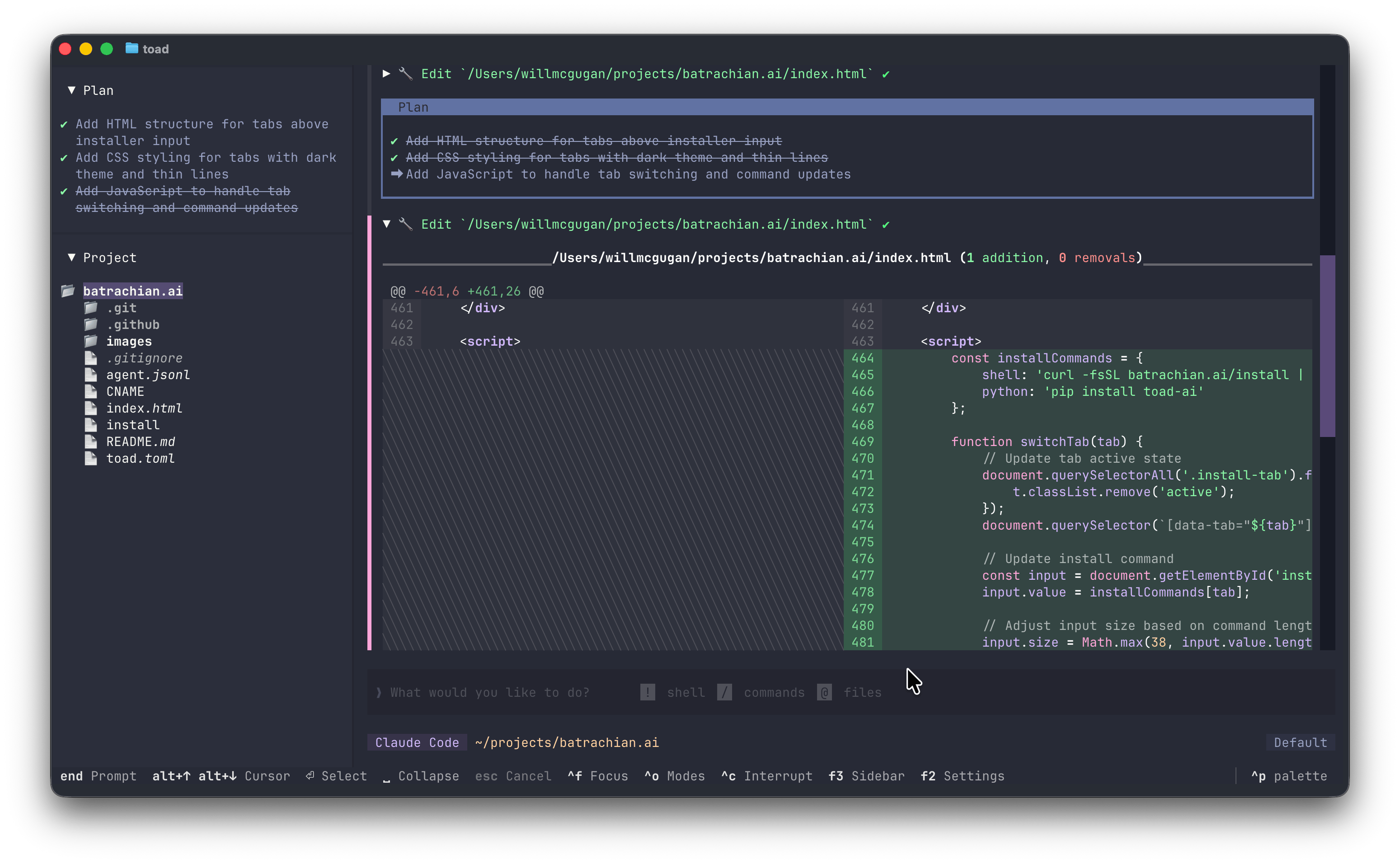
Toad is a universal terminal interface for AI agents, created by Will McGugan, the creator of the popular Python libraries Rich and Textual.
The name comes from “textual code”—combining the Textual framework with coding assistance.
Why Toad?
Toad provides a modern terminal user experience that addresses several limitations common to existing terminal-based AI tools:
- No flickering or visual artifacts - Toad can update partial regions of the screen without redrawing everything
- Scrollback that works - You can scroll back through your conversation history and interact with previous outputs
- A unified experience - Instead of learning different interfaces for different AI agents, Toad provides a consistent experience across all supported agents through ACP
OpenHands is included as a recommended agent in Toad’s agent store.
Prerequisites
Before using Toad with OpenHands:
- OpenHands CLI installed - See Installation
- LLM settings configured - Run
openhands and use /settings
Installation
Install Toad using uv:
For more installation options and documentation, visit batrachian.ai.
Setup
Using the Agent Store
The easiest way to set up OpenHands with Toad:
- Launch Toad:
uvx batrachian-toad
- Open Toad’s agent store
- Find OpenHands in the list of recommended agents
- Click Install to set up OpenHands
- Select OpenHands and start a conversation
The install process runs:
Manual Configuration
You can also launch Toad directly with OpenHands:
Usage
Basic Usage
With Command Line Arguments
Pass OpenHands CLI flags through Toad:
Resume a Conversation
Resume a specific conversation by ID:
Resume the most recent conversation:
Find your conversation IDs by running openhands --resume in a regular terminal.
Advanced Configuration
Combined Options
Environment Variables
Pass environment variables to OpenHands:
Troubleshooting
”openhands” command not found
Ensure OpenHands is installed:
Verify it’s in your PATH:
Agent doesn’t respond
- Check your LLM settings:
openhands then /settings
- Verify your API key is valid
- Check network connectivity to your LLM provider
Conversation not persisting
Conversations are stored in ~/.openhands/conversations. Ensure this directory exists and is writable.
See Also

